Knowing when to use the right meter is critical to well-functioning processes. Understanding power consumption demands a multifunctional meter. However, if you are looking to understand why a system is losing efficiency or to detect issues, it requires deeper analysis. That is where understanding the difference between a power analyzer vs multifunction meter becomes important. Both are electrical measuring instruments and can measure parameters such as voltage, current, power and power factor. The two can overlap in their capabilities, so the right choice depends on the level of monitoring and analysis required
So, which one should you choose? It depends on the question you need the instrument to answer.
What is a Multifunction Meter?
A multifunction meter combines several electrical readings in one device, such as voltage, current, power, frequency and power factor. It works best for systems that need regular monitoring, but not detailed fault breakdown. For example, a plant can use one to monitor a production line, while a facility manager can track energy use across distribution panels.
Choose a multifunction meter when tracking electrical performance is the priority rather than detailed fault detection. Depending on the model, a multifunction meter can measure:
- Voltage
- Current
- Active power
- Reactive power
- Apparent power
- Power factor
- Frequency
- Energy consumption
- Harmonics
Newer models have modern communication systems and even remote monitoring. For example, Beemet’s multifunction meters are designed to reduce panel space, wiring and installation time. With options such as RS485 communication, harmonic measurement is also available. This makes a multifunction meter a practical choice for everyday power monitoring.
What is a Power Analyzer?
A power analyser is an excellent tool for engineers to quickly assess how an electrical system is behaving as a whole. It goes beyond power consumption and studies other factors too. Depending on the model, a power analyzer can provide deeper analysis of voltage, current, harmonics, distortion and, in advanced instruments, waveform behaviour. This makes it useful for systems with variable frequency drives, inverters, and switching power supplies.
A power quality analyzer can help investigate issues such as:
- Harmonic distortion
- Voltage fluctuations
- Current distortion
- Power factor problems
- Phase imbalance
- Abnormal electrical behaviour
- Changes in power quality over time
While most applications don’t need this complexity, it helps when you are looking to identify specific electrical problems in a system.
Power Analyzer vs Multifunction Meter: Key Differences
Factor | Multifunction Meter | Power Analyzer |
Main purpose | Routine electrical and energy monitoring | Detailed electrical analysis and troubleshooting |
Typical measurements | Voltage, current, power, energy, PF, frequency | Voltage, current, power, energy, PF, harmonics and other advanced measurements |
Power quality analysis | Available in selected models | Often a key application, depending on model |
Harmonic analysis | Available in selected models | Often available, with greater depth on advanced models |
Waveform analysis | Limited or model-dependent | Available on some advanced models |
Installation | Often panel-mounted | Can be panel, portable or test-system based |
Best suited for | Panels, distribution systems, gensets, routine monitoring | Diagnostics, testing, troubleshooting and detailed analysis |
Cost | Generally lower | Generally higher |
It helps understand | “What is happening?” | “Why is it happening?” |
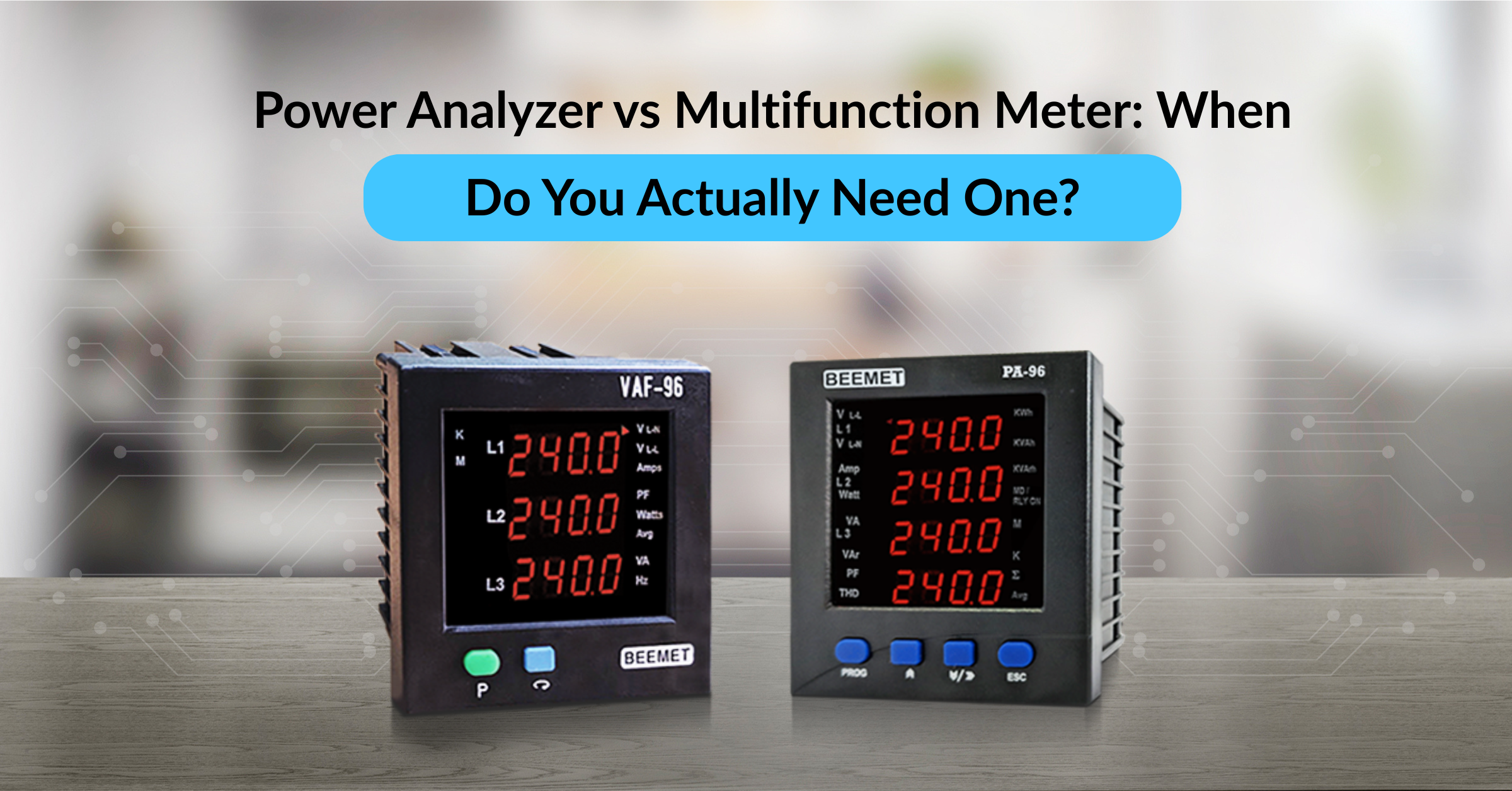
Some advanced multifunction meters also offer harmonic measurement and other analyzer functions. An example of this is Beemet’s PA-96 range, which is positioned as a multifunction meter/power analyser. It includes total and individual harmonic measurement, maximum demand and optional RS485 communication.
When to Use a Multifunction Meter
Choose a multifunction meter when your primary requirement is power monitoring.
You need routine monitoring.
If your system needs regular checks of basics like voltage, current, and power, then a multifunction meter works best. It works well in panels where readings need to stay visible during operation.
You want several parameters in one device.
If you have multiple parameters, then one device works instead of setting up individual meters and wiring. A multifunction meter combines these readings in one instrument, making it useful for control panels, distribution systems and generator sets.
For applications that require multiple electrical parameters in one device, explore Beemet’s Multifunction Meters for panel monitoring and electrical measurement.
You are tracking energy consumption.
An energy meter tracks overall energy use in kWh. A multifunction meter adds context by showing parameters such as current and power factor alongside consumption. This helps identify changes in how equipment uses energy.
You need remote monitoring.
Many multifunction meters support communication, allowing measured data to be delivered to monitoring or automation systems. For facilities with multiple panels, it also reduces the need for manual readings.
Demand for a practical panel-mounted solution
A multifunction meter is a practical, easy-to-install and cost-effective solution for everyday industrial applications. It suits distribution boards, control panels, gensets and other fixed electrical installations. Beemet offers meters designed for these applications.
For a deeper look at how multifunction meters support energy monitoring, see Beemet’s guide to multifunction meters in energy management.
When to Use a Power Analyzer
A power analyzer becomes useful when the measurement itself needs investigation.
Troubleshooting Power Quality
When equipment behaves unexpectedly due to heat or tripping, a basic power reading may not explain why. A power quality analyzer helps identify issues such as harmonics, distortion, and voltage fluctuations.
Testing Equipment
Motors, drives, inverters, and power supplies may require detailed power measurement during testing. A power analyzer helps compare performance, efficiency, and behaviour under different loads.
Checking Harmonics
Electronic loads can introduce harmonic currents into an electrical system. Power quality meters with harmonic measurement can help detect and assess these issues.
Finding the Cause
A power analyzer helps investigate what is causing unusual readings or performance during testing and troubleshooting.
Detailed Analysis
Advanced analyzers can capture waveforms and provide harmonic and multi-channel measurements. These features are useful when dealing with changing or distorted electrical loads.
Common Mistakes When Choosing Between the Two
Mistake | Why It Can Be a Problem | Better Approach |
Choosing only by price | A cheaper instrument may not provide the information you need | Start with your measurement requirements |
Buying an analyzer for basic monitoring | You may pay for advanced functions you never use | Choose a multifunction meter for routine monitoring |
Choosing a basic meter for troubleshooting | Basic readings may not explain the cause of a problem | Use a power analyzer when detailed diagnostics are required |
Assuming every multifunction meter has the same features | Harmonic measurement, communication and accuracy vary by model | Check the technical specifications |
Ignoring future requirements | You may need to replace the instrument when monitoring needs expand | Consider communication and additional measurement functions |
Focusing only on accuracy | Accuracy depends on the measurement conditions and application | Check accuracy, range, frequency and waveform requirements together |
The biggest mistake is treating the power analyzer vs multifunction meter decision as a simple “better versus cheaper” comparison.
It is really a question of measurement depth.
For more advanced electrical measurement and analysis, explore Beemet’s Power Analyzers and their available measurement capabilities.
How to Decide: A Quick Checklist
Before selecting one of these power monitoring devices, ask:
- Measurement needs: Identify the parameters you need to measure, such as voltage, current, power, energy or power factor.
- Application: Decide whether you need routine monitoring or detailed testing and troubleshooting.
- Power quality: Check whether you need harmonic, distortion or waveform analysis.
- Connectivity: Confirm RS485, Modbus or other communication requirements for system integration.
- Installation: Decide whether you need a fixed panel-mounted meter or a portable instrument.
- Future requirements: Consider whether you may need additional measurements or communication features later.
- Specifications: Compare accuracy, measurement range and available functions before purchasing.
Quick rule: Choose a multifunction meter for regular monitoring. Choose a power analyzer when you need to investigate electrical behaviour or power quality in greater detail.
Conclusion
The right choice depends on what you need to measure. A multifunction meter suits routine monitoring, while a power analyzer is better for detailed testing and power quality analysis.
For applications that need both, Beemet’s PA-96 range combines multifunction measurement with harmonic analysis and optional RS485 connectivity, offering a practical solution for advanced electrical monitoring. That approach helps you choose based on the job the instrument needs to do, rather than simply buying the most advanced option available.
If you are also comparing different types of electrical meters, read Beemet’s guide to Digital Panel Meter vs Multifunction Meter to understand which option best suits your application.
FAQs
A multifunction meter is mainly used for routine monitoring of voltage, current, power and energy. A power analyzer goes further, helping you investigate power quality, harmonics and waveform issues.
Yes. It can monitor parameters such as voltage, current, power, power factor and energy consumption, making it suitable for regular monitoring in fixed installations.
Use a power quality analyzer when you need to find issues such as harmonics, distortion, voltage fluctuations or phase imbalance.
No. A power meter mainly measures electrical power and related values. A power analyzer provides more detailed information to help investigate electrical problems.
Some models can. Always check the specifications before buying. For example, Beemet’s PA-96 range can measure both total and individual harmonics.
Start with what you need to measure. Then check accuracy, measurement range, phase type, harmonic measurement, communication options and installation requirements.
Neither is better for every application. Choose a multifunction meter for regular monitoring and a power analyzer when you need detailed testing or troubleshooting.