
One of the biggest risks in any electrical system is earth leakage. Electrical systems require protection against protection against earth leakage faults. When current leaks outside its regular path, it flows to earth. This can lead to equipment damage, electric shock or fire.
A Core Balance Current Transformer (CBCT) plays a critical role in identifying this leakage current. It works in conjunction with an Earth Leakage Relay (ELR) to monitor an electrical circuit. When a leakage current crosses a set limit, it initiates a trip. CBCTs are used in industrial panels, distribution systems, motor control panels and other electrical installations.
What Is a Core Balance Current Transformer (CBCT)?
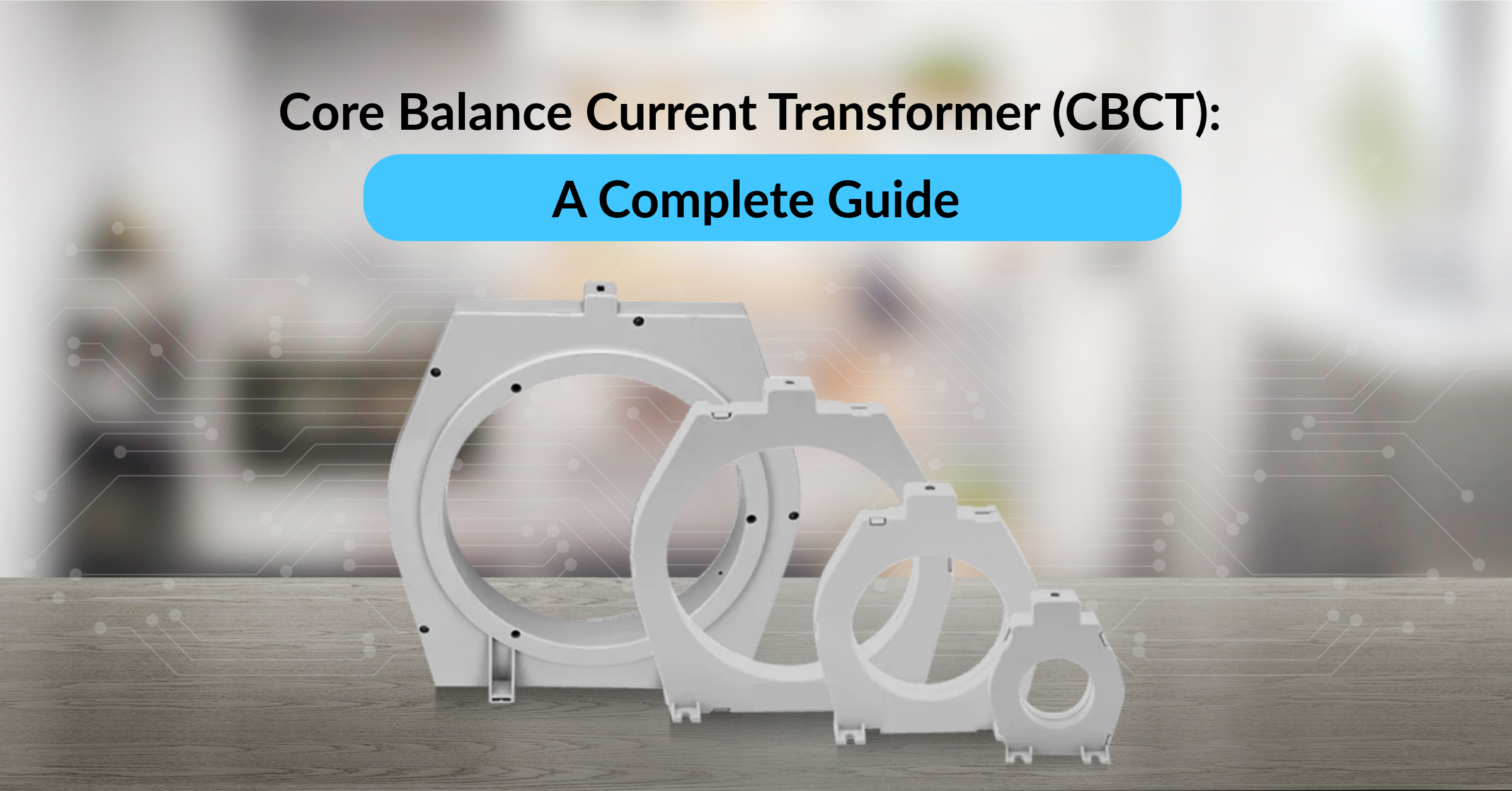
A CBCT is a toroidal current transformer that detects earth leakage or earth fault current. Unlike a standard CT, a CBCT monitors the combined current flowing through the conductors of a circuit.
In a three-phase system, all three phase conductors pass through the centre of the toroidal CBCT. If the neutral is part of the circuit, it also passes through the same CBCT core.
A CBCT is used for earth-leakage protection. It works with an Earth Leakage Relay (ELR), which monitors the CBCT signal and can disconnect the circuit when leakage exceeds the set limit.
How Does a CBCT Work? (Working Principle)
The working principle is based on detecting residual or zero-sequence current. In a three-phase system, current flows through the three-phase conductors. The currents balance each other inside the CBCT core. Therefore, the net magnetic flux is close to zero. The secondary winding of the CBCT produces little or no output.
But when an earth fault occurs, some current now takes an off-route path to earth instead of returning through the normal conductors. The current balance is disturbed, producing a residual current. The ELR receives this signal. If the leakage reaches a set level, the relay sends a trip command to the circuit breaker, thus isolating the circuit.
In simple terms, the CBCT detects the imbalance, while the ELR determines when it is high enough to trigger protection.
CBCT vs Standard Current Transformer — Key Differences
A CBCT and a standard current transformer both use electromagnetic induction. However, they serve different purposes.
Parameter | CBCT | Standard Current Transformer |
Main purpose | Detect earth leakage or earth fault current | Measure or monitor load current |
Measurement | Residual current or current imbalance | Current in an individual conductor |
Construction | Usually a toroidal core surrounding multiple conductors | Usually installed around or connected to one conductor |
Normal operation | Output remains very low when currents balance | Produces output based on load current |
Typical connection | Connected to an ELR or earth fault relay | Connected to meters, protection relays or monitoring devices |
Main application | Earth leakage protection | Metering and overcurrent protection |
A CBCT is designed and applied specifically to detect small residual currents. To understand how standard CTs work for metering and protection, read our Current Transformer Guide.
CBCT with Earth Leakage Relay (ELR) — How They Work Together
A CBCT and earth leakage relay arrangement uses two main components: the CBCT and the ELR. The CBCT is the sensing device used to detect the residual current in the circuit. It then sends a corresponding signal to the relay.
The ELR processes this signal. Used to identify when leakage current exceeds the set limit, the relay operates its output contact. This contact can be connected to a circuit breaker, contactor or other protection mechanism to disconnect the affected circuit.
An ELR with CBCT is useful because the two components perform separate jobs. Modern digital ELRs can also offer adjustable trip levels and time delays. Beemet’s digital ELR allows users to set the trip level from 0.03 A to 30 A and adjust the trip delay from 0.04 to 10 seconds. It also has CBCT open-circuit detection for added reliability.
The correct combination of CBCT and ELR is important. The CBCT size, ratio and relay input must be compatible with the application.
Types of CBCT & Key Specifications to Check Before Buying
CBCTs are available in different sizes and configurations. Here are the key specifications to check:
Inner diameter:
The CBCT opening must be large enough for all conductors that need to pass through it. Beemet recommends choosing a toroid with an inside diameter at least twice the outside diameter of the cables being passed through.
Current ratio:
The ratio controls the relationship between the primary residual current and the secondary output. Beemet’s BEE CBCT range includes ratios such as 1:1000″ and “1:600, with other ratios available on request.
Leakage-current range:
Select a CBCT and ELR combination that can detect the expected leakage level without causing unwanted trips.
System voltage and frequency:
Check that the CBCT is suitable for the electrical system. Beemet’s CBCT specifications include a maximum system voltage of 720 V and 50/60 Hz operation.
Installation space:
The CBCT should fit comfortably around the conductors without forcing or bending the cables.
ELR compatibility:
Always confirm that the CBCT output meets the ELR’s input requirements.
Installation Best Practices
Correct installation is important for reliable CBCT operation. Even a suitable CBCT can give incorrect results if the conductors are routed incorrectly.
Keep these points in mind:
- Pass all required phase conductors through the same CBCT core.
- Where applicable, pass the neutral conductor through the same core as the phase conductors.
- Do not pass the protective earth conductor through the CBCT during normal installation.
- If an earth conductor or cable sheath arrangement requires special routing, follow the manufacturer’s connection diagram.
- Keep the cable near the centre of the toroid where practical.
- Install the CBCT on a straight section of cable rather than close to a sharp bend.
- Keep the CBCT away from strong external magnetic fields.
- Do not route individual conductors through separate CBCTs when the application requires residual-current measurement.
The CBCT should also be correctly matched to the ELR. Poor wiring, an unsuitable CBCT size or wrong relay settings can result in missed leakage detection or nuisance tripping.
Conclusion
A CBCT is a practical solution for earth-leakage protection in industrial and electrical applications. Its performance depends on choosing the right size, current ratio and compatible ELR, along with proper installation.
With the right combination, CBCT and ELR systems can provide protection against earth leakage and help prevent damage to electrical equipment. To learn about other electrical measuring instruments used in panels and distribution systems, read our detailed guide.
Explore Beemet’s BEE CBCT range to find the right fit for your application.
FAQs
CBCT stands for Core Balance Current Transformer. It detects residual or leakage current and is commonly used with an Earth Leakage Relay for protection.
A CBCT is mainly used to detect earth leakage and earth fault current in electrical systems. It sends a signal to a relay when it detects a current imbalance.
A standard CT generally measures current flowing through an individual conductor. A CBCT measures residual current by monitoring the combined current through multiple conductors.
The CBCT detects the leakage current, while the ELR monitors the signal and initiates a trip when the leakage reaches the set level.
Yes. In applications where neutral is part of the monitored circuit, it should pass through the same CBCT as the phase conductors. The exact arrangement should follow the manufacturer’s wiring instructions.
Check the outer diameter and arrangement of the conductors that must pass through the CBCT. The inner diameter should provide enough clearance without forcing the cables into position.
CBCTs are used in industrial electrical panels, distribution systems, motor protection systems, generator control panels and other installations requiring earth leakage protection.