Accurately measuring voltage, current, power, and energy consumption requires reliable electrical meters. Any electrical room you enter will have these, but they may serve different purposes. Choosing the right meter ensures you get the features your application actually needs without paying for functions you’ll never use. Choosing the wrong features that you may never use is a waste of resources.
If you’re comparing a digital panel meter vs. a multifunction meter, start with one question: Do you only need to monitor electrical parameters, or do you need to analyse them too?
Managing an OEM panel requires a simple panel meter, whether for monitoring a single machine or replacing an existing meter. However, industrial facilities require more complex systems. For instance, energy usage and connecting multiple software systems for automation. A multifunction energy meter works effectively in such cases.
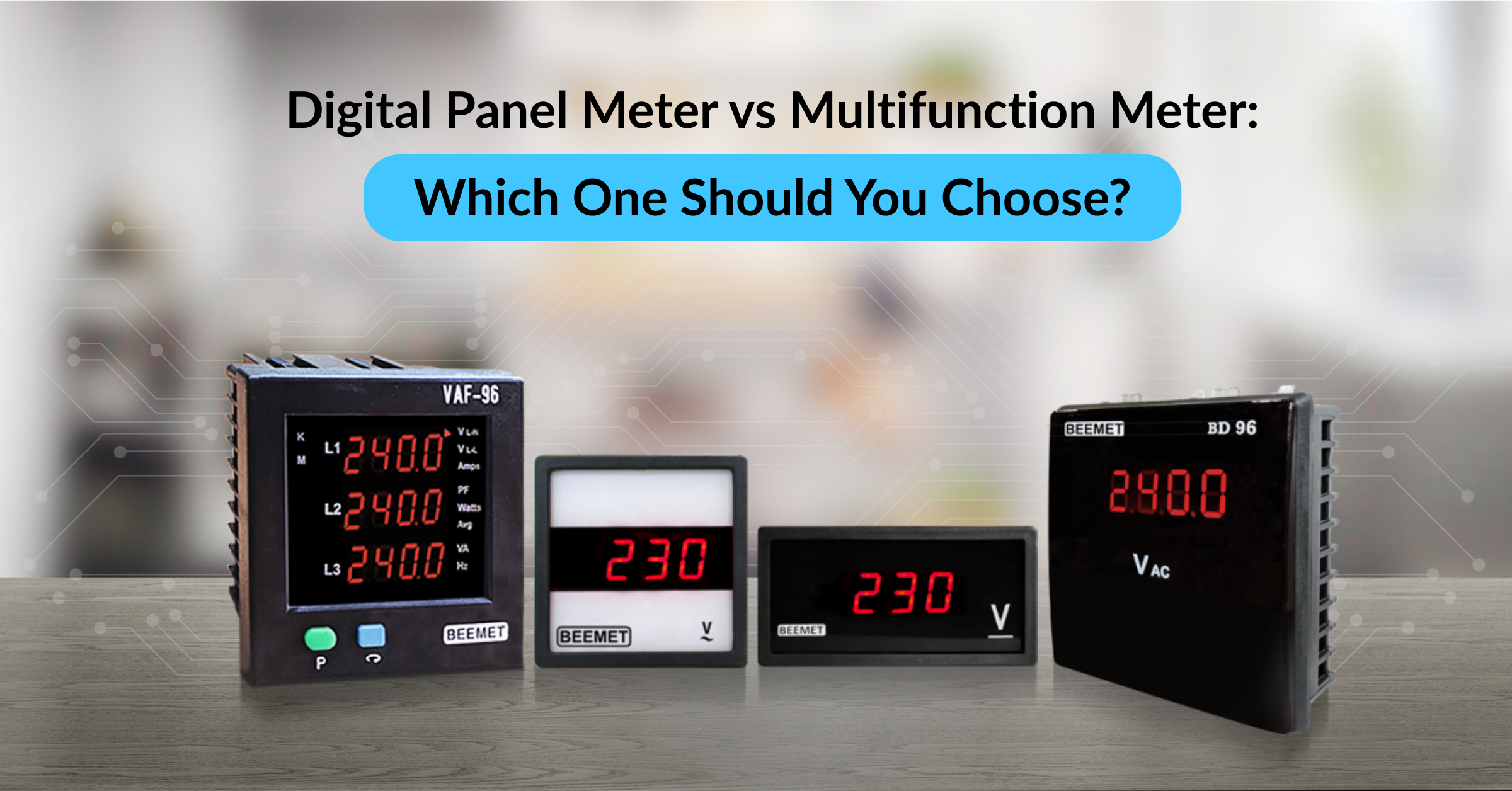
Digital Panel Meter vs Multifunction Meter
Feature | Digital Panel Meter | Multifunction Meter |
Best for | Monitoring one or two electrical parameters | Complete electrical and energy monitoring |
Measures | Voltage, current, frequency or similar values | Voltage, current, power, energy, power factor, frequency and more |
Replaces multiple meters | No | Yes |
Remote monitoring | Limited | Yes |
Communication | Available in selected models | Usually includes RS485 and Modbus communication |
PLC & SCADA integration | Limited | Designed for automation systems |
Ideal applications | OEM panels, machines, and pump panels | Industries, commercial buildings, utilities and energy management |
Digital panel meters offer insight into real-time information. Multi-functional energy meters give you a more holistic insight into what’s happening within.
Application-Based Comparison: Which Meter Fits Your Industry?
OEM Panels and Machine Builders
OEMs usually require operators to monitor basic factors like voltage, current or frequency. A panel meter works as an effective solution for this requirement. Meters are easy to install and operate. They fit into almost any machine control system.
Manufacturing Plants
Manufacturing facilities demand a complex understanding of processes. These monitor real-time readings and energy consumption patterns, load distribution, etc.
A three-phase multifunction meter gives maintenance teams a complete view of electrical performance. It also helps identify overloaded circuits or any possible phase imbalances. It also offers insights into unnecessary energy consumption that can be costly.
Commercial Buildings
Bigger network systems, such as hotels, malls, and commercial buildings, have high-end electrical systems. For safety purposes, these are regularly monitored. Here, multifunctional energy meters help facility managers compare energy usage across floors and units.
Utilities and Infrastructure
Other facilities, like major power distribution panels and substations, demand utility in stations that need monitoring. Multifunctional meters provide detailed electrical data for safe operation and quick fault flagging.
If energy efficiency is one of your priorities, our blog on the applications of multifunction meters in energy management explains how these meters support smarter energy monitoring and cost optimization.
Key Technical Factors for Selecting a Panel Meter
Learn about the different electrical measuring instruments before making the final decision of choosing the right panel meter.
Number of parameters
For those who just need to display voltage and current, digital panel meters are enough. For systems that need to analyse power, frequency, and multiple facets together, a multifunctional meter is a better go-to choice.
Single-phase or three-phase systems
Three-phase multifunctional meters operate simultaneously, making them suitable for LT panels, MCC panels, switchgear, and boards.
Accuracy
Applications such as energy audits, billing, and power quality analysis require higher measurement accuracy. Always choose a meter that meets the accuracy standards required for your industry.
Future expansion
Businesses that expect immediate or near-future expansions must equip their facilities in advance. Selecting a meter with communication capabilities today can save significant upgrade costs later.
For a better understanding of different measurement devices and their applications, refer to the electrical measuring instruments guide before selecting the right meter.
How the Two Meters Compare in Installation and Connectivity
Digital panel meters are relatively easier to install due to minimal wiring and configuration, thus making them ideal for simpler applications.
Multifunctional meters require more thorough configuration than simple panel meters, as they measure multiple parameters. Most modern systems include an RS485 meter, allowing reliable communication over long cable distances in industrial environments. Many also function as Modbus meters, making them compatible with equipment from different manufacturers without requiring proprietary software.
If your facility already uses industrial automation, compatibility is crucial. A PLC meter sends real-time electrical data to Programmable Logic Controllers. It allows easier automation of equipment monitoring and process control.
A SCADA meter communicates with Supervisory Control and Data Acquisition systems. Operators can monitor multiple electrical panels from a single location and receive alerts when abnormalities occur. It also analyses historical trends without visiting each control panel.
Together, these capabilities help the modern power monitoring system function. This gives operators greater visibility into electrical performance while reducing the need for manual inspections.
When Should You Upgrade to a Multifunction Meter?
Many facilities start with basic panel meters. Consider upgrading when:
- You need more than voltage or current readings.
- Multiple individual meters are installed on the same panel.
- Energy costs have become a concern.
- You want to monitor power factor or demand.
- Your facility is implementing SCADA, PLC, or Building Management Systems (BMS).
- You need historical energy data for reporting or audits.
Multifunction meters generally cost more, especially in the initial stages. It often reduces overall installation costs by replacing multiple devices and simplifying wiring. Before upgrading, understanding how multifunction meters work and their benefits can help businesses select the right solution for their electrical monitoring needs.
Panel Meter Selection Checklist Before Purchase
Before selecting a meter, ask yourself these questions:
- Which electrical parameters do I actually need to measure?
- Is the application single-phase or three-phase?
- Will the meter only display values locally, or should it communicate with other systems?
- Do I need RS485 or Modbus communication?
- Will the meter connect with an existing PLC or SCADA system?
- Am I planning to add energy monitoring in the future?
- Would one multifunction meter replace several individual meters?
Answering these questions will help you choose the right electrical measuring instruments for both your current and future requirements.
Conclusion
The choice between a digital panel meter and a multifunction meter comes down to your monitoring needs. If you only need to display basic electrical parameters, a panel meter offers a simple and cost-effective solution. For more complex monitoring, a multifunction meter offers greater long-term value.
Whether you’re upgrading an existing panel or designing a new electrical system, choosing a reliable meter is just as important as choosing the right type of meter. Beemet offers a range of digital panel meters and multifunction meters built for accurate measurement. It offers dependable performance and seamless integration with modern industrial applications.
FAQ
A digital panel meter measures one or a few electrical parameters, while a multifunction meter measures several parameters, including voltage, current, power, energy, and power factor, from a single device.
Choose a three-phase multifunction meter when you need complete monitoring of three-phase electrical systems in industrial plants, commercial buildings or power distribution panels.
Yes. Most multifunction meters support RS485 and Modbus communication protocols, enabling seamless integration with PLC and SCADA systems for remote monitoring.
Yes. If your requirement is limited to monitoring voltage, current or frequency on a single machine or control panel, a panel meter is usually sufficient.
A multifunction energy meter measures multiple electrical parameters, records energy consumption, and supports remote monitoring, helping businesses improve efficiency and reduce energy costs.