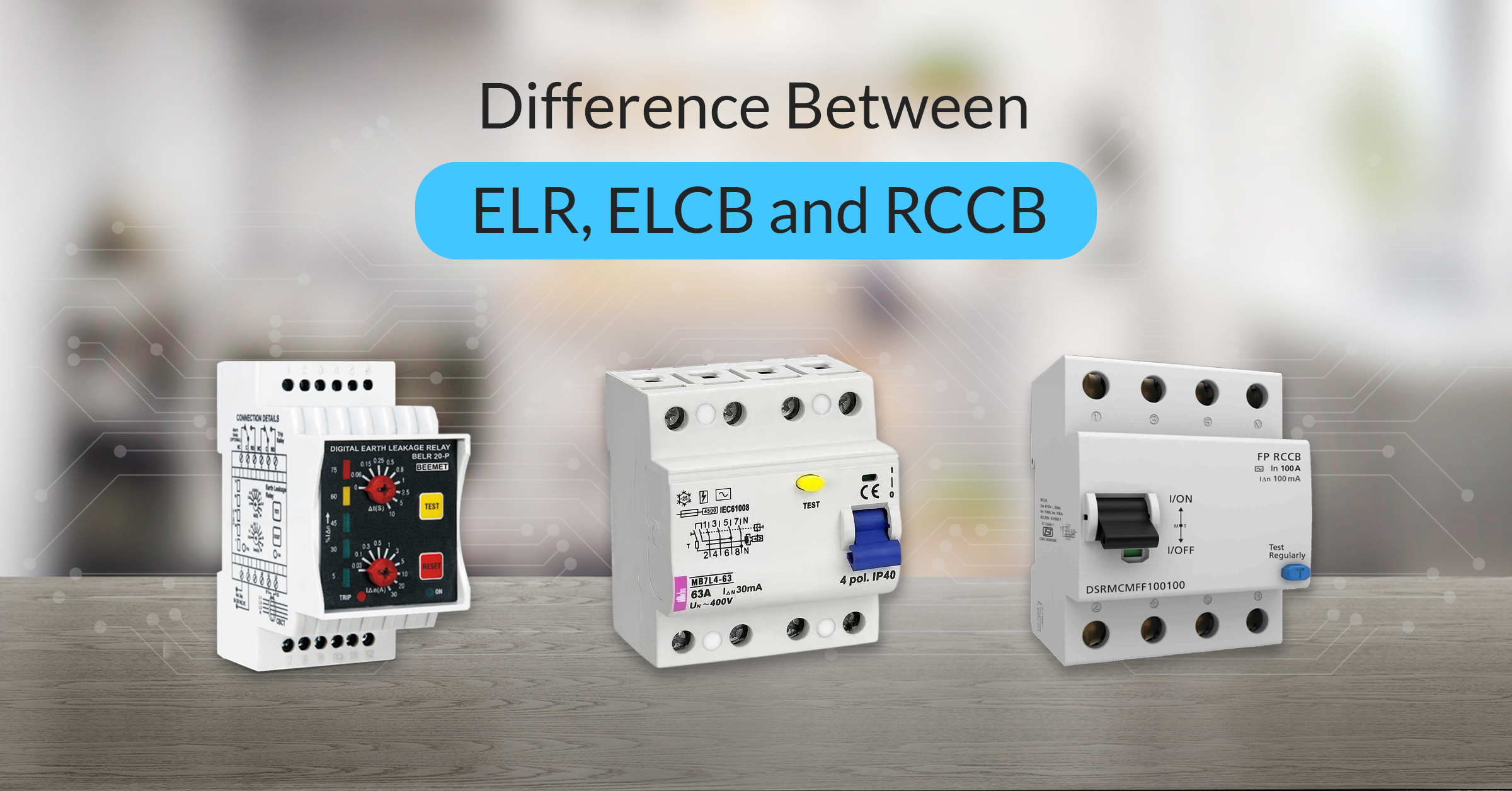
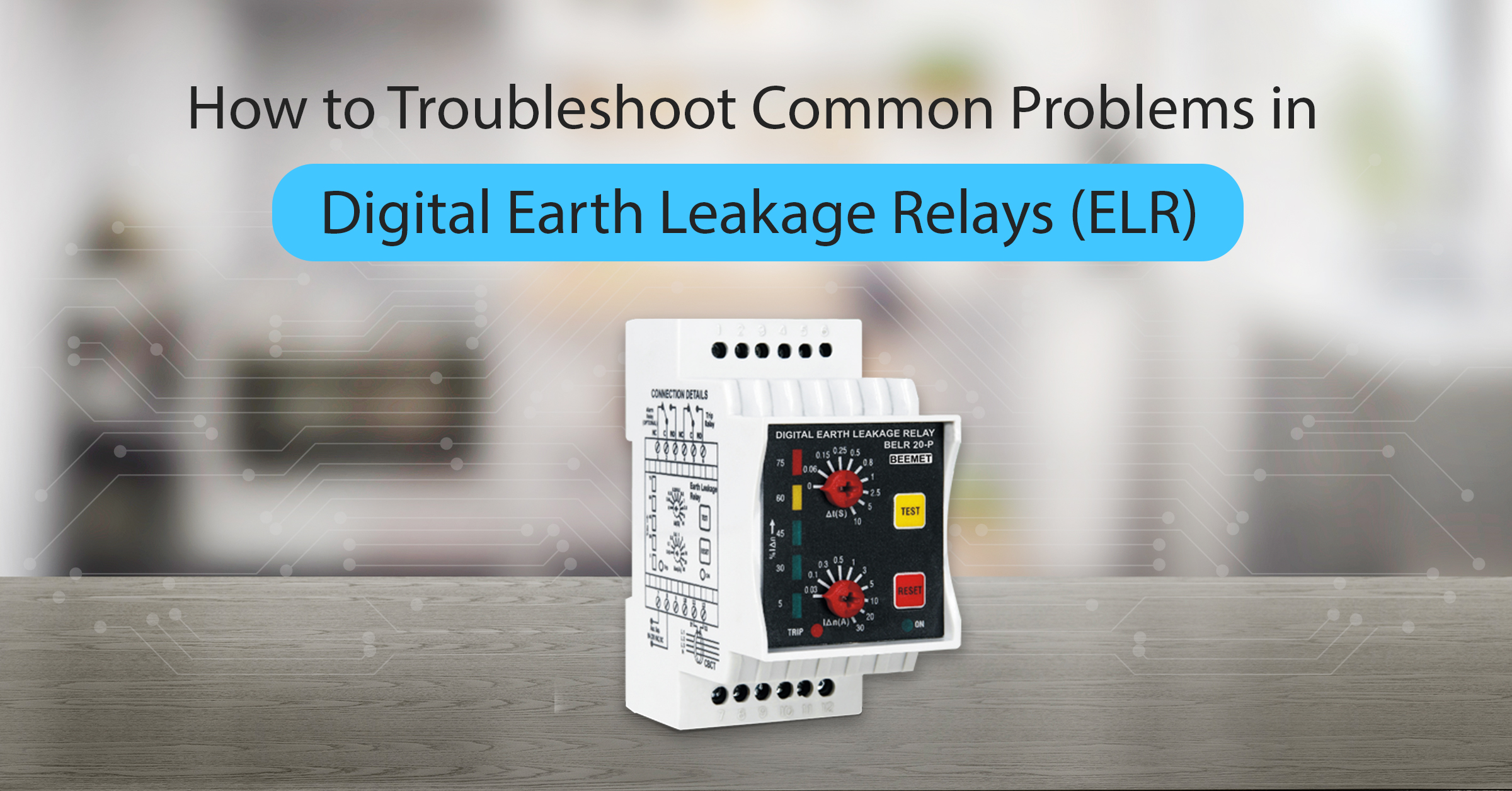
Modern electrical systems can cause safety and equipment hazards in case of earth leakage. Such dangers are usually prevented using digital Earth Leakage Relays (ELR). The moment it detects an abnormal current, it cuts power and prevents hazards.
Even the best systems can face challenges. For example, a relay may react to electrical transients and trip unnecessarily, or worse, it might miss a genuine leak and fail to act. That’s why it’s important to carefully evaluate these scenarios and plan solutions. In this blog, we walk through the most common ELR issues and share practical ways to address them.
Understanding Digital Earth Leakage Relay Components
An ELR is a device that checks the flow of electricity through a sense core (CBCT) to make sure it is balanced. It sends a signal to the breaker to trip when the balance is lost. This prevents digital elr faults from harming equipment or people.
A basic system includes:
- A microprocessor that analyses current
- A display that shows readings and relay status
- A CBCT sensor that detects leakage
- Relay outputs and test functions that trigger tripping
If something goes wrong, you must check each component separately. Issues may arise from overloaded CTs, the algorithm responding to noise instead of leakage, faulty wiring, or tight terminals. It is therefore important to check fault assumptions before using them.
The CBCT sensor plays a critical role by detecting current imbalance, which is explained in detail in our guide on current transformers and their working principles.
Common Digital ELR Problems and Diagnostic Steps
Some common digital elr problems with their diagnostics steps are :
False tripping
This occurs when the relay is tripping without a real ground fault. Harmonics, surges, or poor CT wiring usually cause it to cut power without saving the system.
What to Check:
- Check loads that may create harmonics.
- Tighten and secure CT wiring.
- Match trip settings with system values.
No trip at actual leakage
Here, a real ground fault exists, but the ELR does not respond. This can lead to insulation breakdown, equipment damage, or shocks.
What to check:
- Use a relay testing tool such as ELR injection tester to simulate rated leakage and observe response time.
- Check the CBCT output voltage for saturation or damage.
Unstable or floating readings
This happens when the reading on the screen keeps going up and down for no reason. It generally means that there is noise interference or bad grounding.
What to check:
- Tighten CT secondary wires.
- Reset the zero reading on the relay.
- Use a meter to check the backup power source.
Communication or display failure
Such failures include blank screens and broken buttons. There will no longer be any monitoring available.
What to check:
- Restart the relay fully.
- Confirm supply stays within 110–240 V.
- Test RS-485 and keys with a loopback.
Systematic Relay Testing Procedures
When subjected to rigorous testing, vague assertions like “it trips sometimes” transform into data that can be measured. Before you begin, ensure the relay is safely isolated before testing and make note of the settings. You can test how fast the relay trips by passing a small amount of leaking current through it. Press the test button and see whether there’s any heat or dangling wires on the screen.
Advanced Diagnostic Techniques for Digital ELR Faults
Looking more closely can be quite useful when problems aren’t obvious. Checking earth resistance and waves for electricity noise is an advanced diagnostic skill for relay faults. Keeping log files can help solve difficult problems. Early warnings are also crucial to power system protection. That alerts you of a system shutdown.
Preventive Maintenance for Panel Protection Systems
Good maintenance will keep relays effective for a long time. It is advisable to run the checks once in a month. You can run injection testing every several months and press the test button monthly. Whenever feasible, you can also update firmware and clean cables. Surge protection and early warning lights prevent surprises. This panel protection system keeps people safe.
When to Replace vs. Repair Digital ELRs
Small concerns like wire cuts or calibration errors can be fixed with repairs. Bigger issues like broken processors or weak CTs require newer parts. Even the age of the relay also matters. When safety is in jeopardy, replacement helps reestablish trust. This will aid in electrical equipment maintenance over time.
For a complete understanding of how protection thresholds, sensing mechanisms, and relay logic work together, you can also read our detailed guide on digital earth leakage relays.
Conclusion
Earth leakage demands instant response and your ELR must act without hesitation. If it trips unexpectedly, fails during a fault, or shows irregular readings, it’s time to test and recalibrate. At Beemet, our ELRs are engineered for reliability, protecting panels without uncertainty. Upgrade now to prevent small warnings from escalating into costly shutdowns or dangerous shocks.
To ensure dependable protection in critical electrical panels, explore our range of digital earth leakage relays designed for accurate detection and long-term operational reliability.
FAQs
What will happen if an ELR trips even when there’s no problem?
This usually means the relay is responding to noise or loose wires. Tripping normally stops with proper wiring and settings.
Why does not an ELR activate on leakage?
This happens because the sensor core may weaken and miss the defect. A quick leak test can verify relay operation.