TL;DR
Panel meters are the frontline of equipment and process safety. Wrong selection can lead to costly downtime, calibration issues and serious non-compliances. The correct meter must be aligned between the meter and the sensor. It must match the environment you operate in, the dust, moisture, or vibration of your floor. Must allow data integration instead of being in a ‘read-only ‘ mode. Having a pre-purchase checklist, as listed in the blog, ensures long-term reliability.
Introduction
Almost 30% of all control panel failures occur due to a selection of the wrong meter. This failure can affect production, lead to system downtime, and even raise safety concerns. In high-risk facilities, accuracy can be the difference between stability and calamity.
A panel meter is a critical piece of monitoring equipment without which your system is under constant threat, which could pose safety risks. Beemet breaks down this step by step guide to understand and choose the right panel meter for you. Pick the right panel meter and cut out the technical risks from your process.
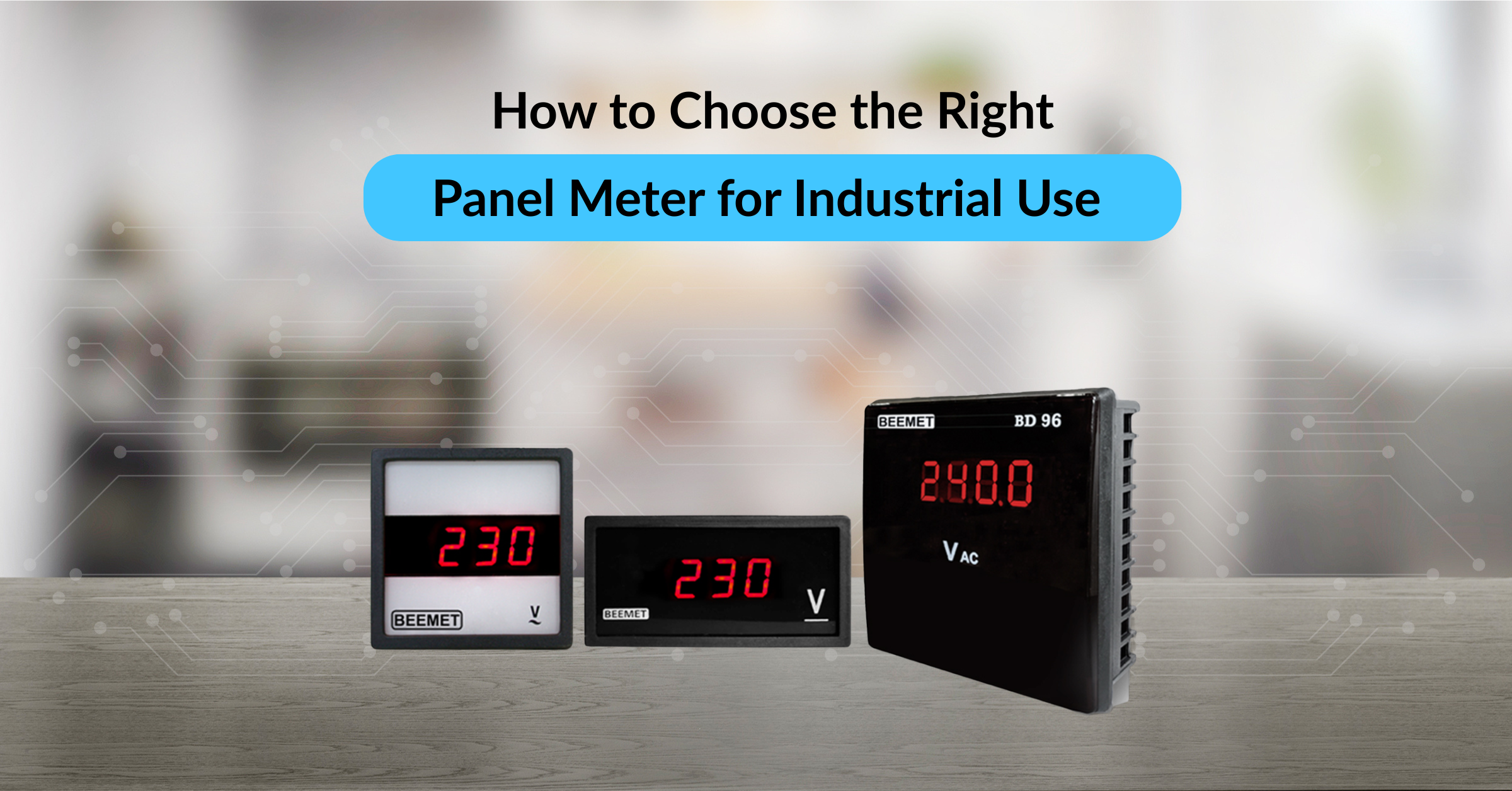
Types of Panel Meters Used in Industry
There are three main types of panel meters used in industrial instrumentation. They differ in terms of functionality and design. These meters are largely categorized as:
Single-Function Meters
Includes devices like a voltmeter, an ammeter, or a power meter. These track one specific parameter, such as voltage, current, frequency, or temperature.
Multifunction Meters
These are advanced units that track multiple electrical parameters simultaneously. These often integrate with communication networks for data logging.
Analog Meters
It uses a moving needle on a calibrated scale to measure electrical quantities. It delivers continuous, real-time measurements, making it ideal for visualizing, fluctuating, or trending information.
Digital Panel Meters
High-resolution numerical displays are used in digital panel meters. These often come with smart alarms and have good connectivity for modern automated systems.
Digital vs Analog Panel Meters
Key features differentiate analog and digital meters. To understand, let’s quickly compare them side by side:
Feature | Digital Panel Meters | Analog Panel Meters |
Accuracy | Pinpoint (up to ±0.1%) | General (~2% margin) |
Readability | Instant numbers; no “guessing” | Need to see the needle clearly |
Toughness | Solid-state; great with vibration | Mechanical parts can wear out |
Power | Needs a power source | Often powered by the signal itself |
Cost | A bit more of an investment | Budget-friendly |
Understanding the differences between analog vs digital panel meters can help businesses choose the right solution for industrial applications.
Key Factors to Consider When Choosing a Panel Meter
To ensure compatibility, always check the specifications carefully before purchasing your panel meter.
The meter must work with your system, so read over the following specs carefully before you buy:
Measurement Requirements
Define the input signal type before selecting a suitable instrument for precise data acquisition.
Accuracy Needs
Determine whether your machines need the precision of digital meters or the qualitative trends of the analog meters.
Environmental Resilience
Assess the workplace conditions (extreme temperatures, vibrations, humidity) to select a robust meter that will operate reliably.
Integration Capabilities
Determine if alarm outputs or data transmission options are required to provide interoperability for data management and alerts.
How to Choose the Right Panel Meter for Different Applications
The working conditions of the system will determine the selection. Be careful and consider every aspect of your working system before selection of a panel meter.
Digital meters, for instance, are ideal for precision applications like manufacturing and chemical processing. These applications need high-resolution readings with no interpolation error.
Analog meters, on the other hand, outperform digital meters in rugged outdoor environments. They are comparatively more resistant to shocks and electromagnetic interference. In fact, many operators select analog meters for trend tracking because needle movement more vividly displays real-time fluctuations than digital readouts.
Businesses looking for industrial-grade panel meters for different operating environments can also explore Beemet’s range of panel meter solutions.
Role of Panel Meters in Industrial Monitoring Systems
Panel meters are the gatekeepers of industrial systems for real-time data display. They help operators quickly evaluate situations. This boosts productivity by eliminating the requirement for remote software management.
These days, digital panel meters can be set up with warning points that turn tools off immediately when there is too much current or voltage. This makes the workplace safer. Without an accurate meter, your operator is in the dark, waiting for problems.
Common Mistakes to Avoid When Choosing a Panel Meter
Avoid these mistakes when choosing the panel:
- Ignoring the “Gunk”: If you put a cheap meter where it gets hosed down or covered in grime, it’s going to short out. Use IP-rated meters like IP66 or IP68K for the longevity of your machine.
- AC/DC Swaps: Using a DC meter on an AC line will not only result in inaccurate reading, but it can also damage the internal components.
- Don’t Underestimate Your Range: Always choose a meter with a range that accounts for both your standard operations and those inevitable power surges. Ensure your equipment stays responsive and accurate even when the grid fluctuates.
- Forgetting Calibration: Calibration is a professional tune-up for your system. If you have not calibrated your meter recently, you are making big decisions based on incorrect readings.
- Shopping on Price Alone: Cheap meters used in industrial contexts generally have low-quality components. As a result, they might result in expensive failures in the long run.
Final Checklist Before Buying a Panel Meter
Category | Checklist Item |
Specs | Do the input and output ranges of the sensor match up? |
Fit | Will your panel cutout accommodate the DIN size? |
Power | Is the auxiliary power source that is needed on hand? |
Safety | What kind of safety certifications does your industry hold? |
Conclusion
Choosing the right meter can be key to your plant’s longevity. Matching your panel meter to the system and environment helps you eliminate performance lapses. The result is peak efficiency even when conditions may falter.
Beemet delivers the accuracy and industrial-grade panel meters required for your toughest applications. Browse our collection today and see how the right meter can streamline your workflow.
To explore more about modern industrial monitoring solutions, you can also read about digital panel meters and their applications.
FAQs
Traditional digital panel meters may be inaccurate due to harmonic distortion in electrical circuits. Use advanced or true-RMS meters for non-linear loads. They’ll measure voltage and current accurately.
You may use an excellent multifunction meter instead of voltmeters, ammeters, and power meters. Construction quality, isolation requirements, and whether one function destroys the device determine reliability.
Electrical noise, ground loops, and voltage spikes can damage measurement accuracy. Input signal isolation guards against these. The instrument and user are protected, especially in high-voltage or dangerous industrial circumstances.