TL;DR
Current Transformers (CTs) safely scale down high electrical currents for measurement. The choice between a 1A or 5A secondary rating depends on one important factor i.e., distance. 5A Secondary is ideal for short distances (under 10m). It is the industry default, but it has high power loss over long cables. 1A Secondary is preferred for distances over 30m. It significantly reduces power loss, allowing for thinner, cheaper wiring without sacrificing accuracy.
Introduction
Electrical systems often carry high currents that need to be monitored and controlled to ensure safety and efficiency. When these currents are not properly monitored, sudden surges can overwhelm the entire system. To address this, current transformers (CTs) are used to reduce the current to levels that can be monitored and safeguarded. This device keeps the system reliable, detects issues early, and reduces the risk of fire and power outages.
However, choosing between a current transformer 1A vs 5A ratings can be tricky. This is especially important because it directly affects system safety and measurement precision. In this blog, we aim to clarify these ratings and help you make confident, informed decisions about your electrical systems.
Understanding Current Transformers (CTs)
What is a Current Transformer?
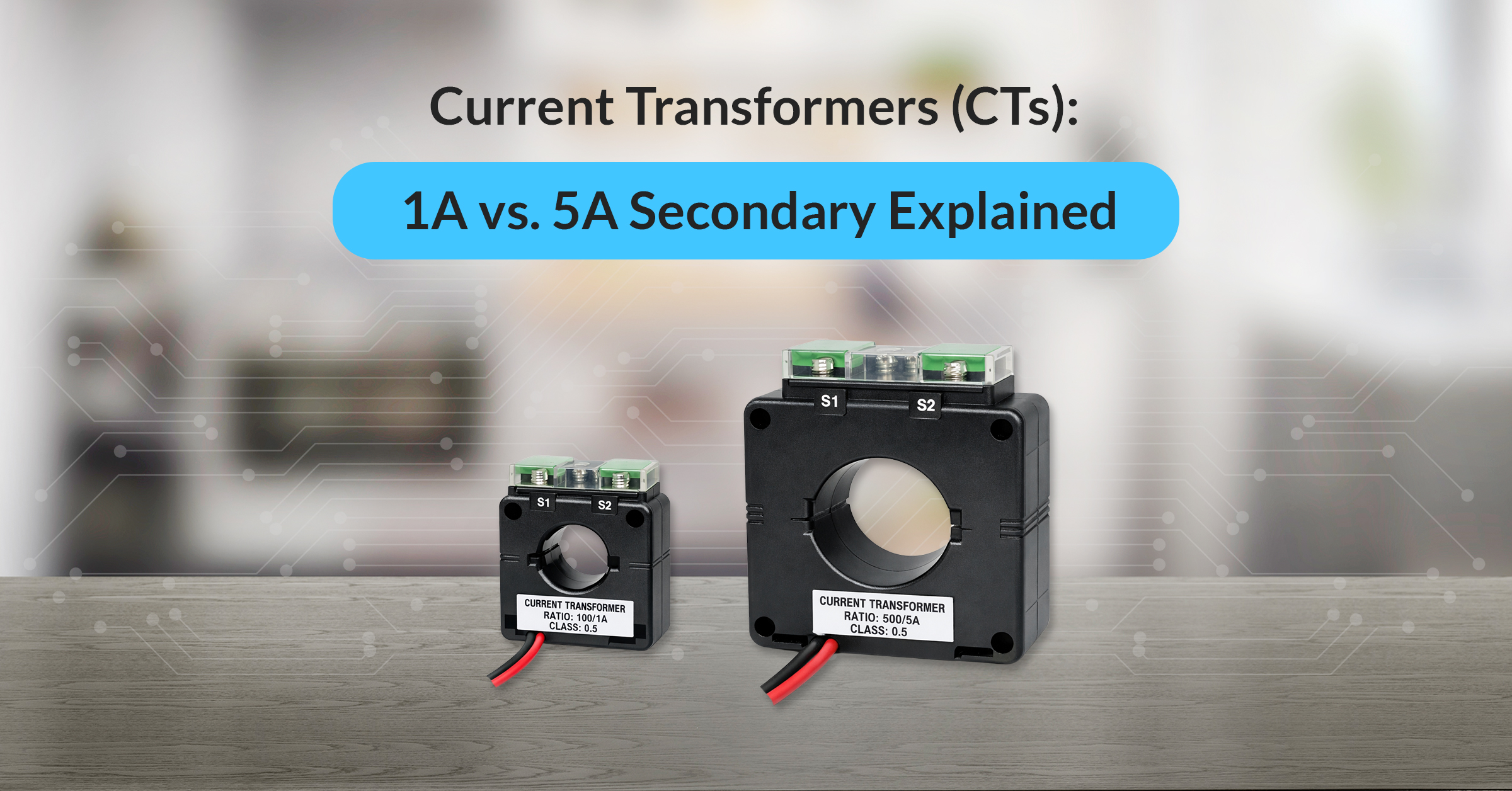
A current transformer can be understood as a doughnut-shaped device that is placed around a power line without making contact. Once installed, it starts detecting magnetic fields, enabling it to produce a much lower current than the high levels found in transmission lines.
For example, if the power line carries 1000A, it can be lowered to a manageable level. This allows for a secure connection between measuring tools, much like how a speedometer determines a car’s speed. Thus, these transformers essentially monitor high-voltage wires, enabling safe and accurate current measurement.
Basic Working Principle
At its core, we see that a CT has two windings:
- The primary winding has a single turn, with the power line passing through its centre.
- The secondary winding has several tiny wire turns around the core.
A magnetic field from the first coil makes the secondary coil conduct electricity at the same rate. For instance, a 1000:5 ratio lowers the main line’s 1000A current to 5A in the secondary circuit. Simply said, its mechanism is similar to a gearbox that slows engine speed to allow a dashboard gauge to function.
For a deep dive into the fundamentals, check out our Current Transformers: A Definitive Guide
Understanding CT Secondary Ratings: 1A vs 5A
What Does Secondary Current Mean?
The secondary rating tells us how much current a current transformer normally puts out when the main load is at full capacity.
Because the requirements are comparable to international standards, we can be confident that meters and switches will function properly.
Why Only 1A and 5A Are Common?
We commonly find only 1A and 5A ratings because of their historical significance and compatibility. 5A was the norm for instruments in the early 20th century due to its sturdy analog relays. After that, 1A was added for digital accuracy. Both can work with current meters and relays. Which one to choose depends on your system’s configuration.
Key Differences Between 1A and 5A CTs
5A CTs are durable and appropriate for industrial applications and relay systems, while 1A CTs are efficient and precise for digital measurements and remote monitoring. Recognizing these applications helps us select the appropriate CT as per the needs of systems. Here is a brief comparison:
Parameter | 1A Secondary CT | 5A Secondary CT |
Secondary current | 1 ampere | 5 amperes |
Power loss | Lower | Higher |
Cable losses | Lower | Higher |
Burden capability | Lower | Higher |
Accuracy over long distances | Better | Slightly lower |
Typical use | Modern digital protection systems | Traditional relay systems |
CT Burden and Power Loss
What is CT Burden?
Burden is the amount of power that a current transformer’s (CT) secondary has to handle. It is measured in volt-amperes (VA) and consists of components such as wiring, meters, and relays. Extra weight can change the CT readings.
How Secondary Current Affects Losses
When electricity flows across a wire, it loses energy as heat. This process is typically explained by what engineers call the I²R rule: losses increase rapidly with current.
For better understanding, consider a 5A CT where higher current leads to increased losses over long cable runs. These losses heat up the cables and cause voltage drops, making long-distance readings less accurate.
As a result, we usually choose 1A CTs for long cable runs in modern power systems.
Why 1A CT Is Often Preferred in Modern Systems
We may prefer 1A CTs because they use less current. This helps to reduce cable heating, dips, and unstable readings. They are ideal for grids that consume less energy and require every watt.
To understand how these components interact across different setups, explore the Role of Current Transformers in Modern Electrical Systems
CT Accuracy Class and Secondary Current
What is Accuracy Class?
During the selection, the CT accuracy class ratings will tell us how accurate current transformers are. For instance, 0.5 is for metering applications that can handle an inaccuracy of ±0.5%, whereas 5P is for protection applications that need to find faults. Like calibrating a ruler, each current transformer class requires finer tolerances for precision work.
Influence of Secondary Current on Accuracy
In case we utilize long cables, a higher current will make us lose more power. This applies especially to extended-connection 5A current transformers (CTs).
In contrast, 1A CTs perform better in these situations because they are reliable for remote installations, such as substation relays from control panels.
Learn How to Select the Right Ammeter & Voltmeter to ensure your readings remain within tolerance.
When to Use a 1A CT/5A CT
If you want the optimum current transformer for your project, you should consider its distance from the switch. In practice, a 1A CT is ideal when the distance exceeds 100 meters. As the distance exceeds 100 meters in digital relays in smart grids and large substations, this CT is suitable for these applications. This makes it a good choice for new setups that want to cut down on losses.
On the other hand, a 5A CT is more effective for shorter distances, typically under 20 meters, especially with older systems that use 5A relays. 5A CTs are recognized for their strength, making them a popular choice in factories where durability takes precedence over precision.
Can You Replace a 5A CT with a 1A CT?
You must ensure that the relays handle 1A inputs before proceeding with replacements. A few older ones may not be able to, but most can. You can recalibrate program settings or numbers after swapping parts. The hardware can’t be recalibrated if it is locked to 5A, so it might be easier to do this after an upgrade. You should always ensure pre-testing to avoid false warnings or tripped circuits.
How to Select the Right CT Secondary Rating
When choosing a current transformer, weighing these factors step by step helps you feel more confident in selecting the right CT secondary rating for your system:
- The first thing to consider is the distance from the meter or relay. You can use 1A for remote connections.
- The second is checking the cable inductance. You should remember that broader cables work better for 5A over short distances, while narrower cables work better for 1A over longer distances.
- You often choose 5A or more transformers for high loads.
- You must follow system and local laws, such as IEC standards.
- If you are thinking about system expansion, a 1A transformer is suitable.
You may even consult an expert to have realistic estimates. This process may benefit from the use of burden calculators.
Conclusion
Ultimately, Current Transformers (CTs) serve one vital purpose: transforming dangerous currents into safe, measurable signals. While 5A remains the traditional standard for older or short-range installations, 1A is the preferred choice for modern, long-distance systems where reducing power loss and cable costs is a priority.
Choosing the wrong rating impacts accuracy and can lead to equipment failure or missed fault detections.
At Beemet, we focus on providing reliable and efficient solutions for modern electrical systems. Whether you are retrofitting a legacy panel or designing a new substation, the right Current Transformers (CTs) secondary is the foundation of a reliable system.
FAQs
The current transformer accuracy class (CT) indicates how well it measures current under normal operating conditions. You can use these classifications to figure out if the CT is good for metering or protection.
The CT burden calculation sums the loads on the CT secondary, such as relays, cables, and meters. This helps you ensure the transformer doesn’t exceed its rated limits and keeps the readings accurate.
The CT burden indicates how well the transformer replicates the primary current on the secondary side. That is, if the load is too large, it can skew the readings and reduce safety accuracy.