
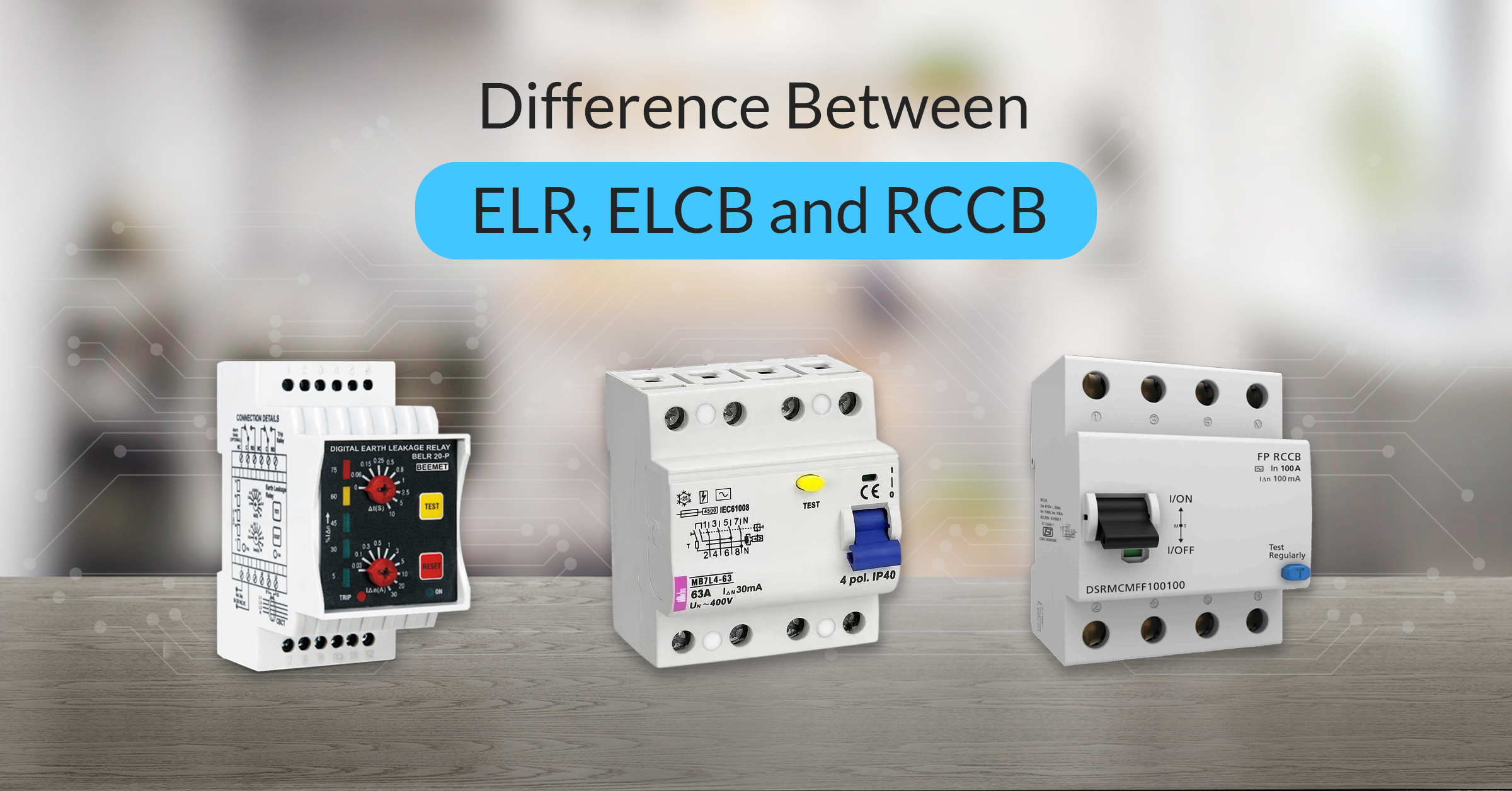
Understanding the differences between ELR, ELCB, and RCCB is essential for ensuring electrical safety in residential, commercial, and industrial installations. Don’t let accidents be a rude wakeup call to be mindful for electrical safety. A minor earth leakage can damage insulation, result in tripping episodes, and in worse case shock or fire. This is why devices such as ELCB, RCCB, and ELR are used to detect leakage and protect electrical systems.
To control risk, electrical systems rely on protection devices such as ELCB, RCCB, and ELR. While these terms are often used interchangeably, they are not the same. Each device detects leakage differently and is meant for specific types of installations
The purpose and principle of each of these devices vary significantly, understanding them is key to having safe electrical circuits. Let’s understand the difference between RCCB and ELCB, knowing where ELR with CBCT fits in. It helps choose the right protection for Indian electrical circuit installations.
What is ELCB?
ELCB or Earth Leakage Circuit Breaker is a critical safety device to detect earth leakage. It works by picking up on voltage rise on the earth conductor. In an episode where leakage occurs the voltage increases thus triggering the breaker.
This approach is dependent on proper earthing. If the earth path is weak or the leakage flows through an alternate route the ELCB will fail to trip. This approach worked on older electrical systems where earthing paths were simple and clear. Since ELCB depends heavily on the quality of earthing, it can become tricky. This is a limitation that makes it unreliable in more modern wiring systems that are more complex.
ELCBs are typically found in:
- Older residential buildings
- Legacy industrial panels
- Installations not yet upgraded
Due to these limitations, ELCBs are no longer recommended for new electrical projects.
What is RCCB?
An RCCB or Residual Current Circuit Breaker provides a more reliable protection against earth leakage. Instead of depending on earth voltage, it consistently compares current flowing through the phase and neutral conductors.
Under normal conditions, the current entering a circuit through the phase returns through the neutral. When earth leakage occurs, a part of this current flows to ground, creating an imbalance. RCCB detects this difference and trips the circuit almost instantly. The quick response minimizes instances of electrical shocks or fires.
This working principle makes RCCB effective even when earthing quality is poor. It responds quickly to small leakage currents, which significantly reduces the risk of electric shock.
RCCB is commonly used for:
- Residential electrical safety
- Commercial buildings
- Circuits where human protection is critical
Because it does not rely on earthing quality, RCCB is considered a standard electrical safety device today.
What is ELR?
Earth Leakage Relay or ELR is designed for more complicated electrical systems. Unlike the RCCB, it does not trip the circuit instantly. Instead, it detects the leakage and sends a signal to the external circuit breaker.
This is why ELR is usually paired with a CBCT or Core Balance Current Transformer (CBCT). This measures the combined current of all phase and neutral conductors. What this setup does is it allows for precise leakage detection even in complex high-load systems.
ELRs are preferred in:
- Industrial plants
- Data centres
- Hospitals and large facilities
In such environments, controlled fault detection is essential to avoid sudden shutdowns.
One of the key advantages of ELR is flexibility. It allows adjustable leakage sensitivity and time delay, which helps prevent unnecessary tripping in large installations.
To understand ELRs in greater depth, including their types, features, and applications, you can explore our detailed guide on Digital Earth Leakage Relays.
ELR with CBCT: The Modern Protection System
An ELR with CBCT offers a more accurate and flexible leakage current detection. The CBCT specializes in sending an imbalance in current flow. While the ELR evaluates whether the leakage exceeds the threshold.
This system, therefore, allows engineers to predefine tripping levels and time delays. As a result, it prioritizes safety without causing downtime or shutdown of entire systems when deemed unnecessary. This system detects low leakage currents and helps protecting equipment and personnel from faults
Unlike RCCB, which trips immediately, ELR allows engineers to define delay settings. This is useful in industrial environments where momentary leakage may occur during startup or load changes.
For industries that demand reliable ground fault protection, this combination is widely considered best practice.
Difference Between ELR, ELCB, and RCCB
All three devices perform the same primary function of preventing accidents by detecting earth leakages. However, the way they function differs
- ELCB detects earth voltage and depends on proper earthing
- RCCB detects current imbalance and offers fast shock protection
- ELR works with CBCT and provides adjustable fault detection
This distinction illustrates the practical difference between RCCB and ELCB. It explains why ELR is used in advanced systems.
|
Parameter |
ELCB |
RCCB |
ELR |
|
Detection method |
Earth voltage |
Current imbalance |
CBCT based sensing |
|
Earthing dependency |
High |
Low |
Low |
|
Sensitivity |
Low |
High |
Adjustable |
|
Direct tripping |
Yes |
Yes |
No |
|
Typical use |
Legacy systems |
Homes & offices |
Industrial installations |
How RCCB Works vs How ELCB Works
The difference between an RCCB and an ELCB becomes more defined when their response to leakage is studied in depth. For instance, RCCB reacts to minor imbalances between the phase and neutral current. It does not rely on or wait upon the voltage to change or the quality of earthing. This makes it a more reliable system, especially to protect people against electrical shock.
ELCB on the other hand responds heavily to earth voltage rises. If the leakage current does not cause a noticeable rise, the ELCB does not detect the threat. Therefore, it does not trip, which can pose safety risks in modern electrical systems.
This fundamental difference in working is the main reason RCCB has replaced ELCB in most new installations.
Earth Fault Relay Working Principle
The earth fault relay’s working principle is to detect an unexpected current imbalance. In an ELR system, the CBCT continuously monitors the current balance passing through all conductors.
Under ideal conditions, the net current is usually zero. When a leakage occurs, this balance is disrupted. The relay senses this disturbance and sends a trip signal to the circuit breaker. This method ensures accurate fault detection with strong isolation, which is important for large electrical networks.
Why Ground Fault Protection Matters
Ground faults may start as small leakages, but eventually can have a severe impact. Even a low-level leakage can have a major impact on the insulation and damage it
Ground faults can be dangerous even when the leakage current is low. Over time, small leaks weaken insulation and increase the risk of overheating and fire.
Effective ground fault protection helps:
- Prevent electric shock
- Reduce fire risks
- Protect electrical equipment
- Improve system reliability
In industrial environments, ground fault protection also reduces downtime and maintenance costs.
Electrical Safety Standards And IEC Compliance
Electrical safety standards are constantly updating in encompass maximum safety measures. This ensures systems have reliable performance metrics. In India, many new installations adhere to IEC standards for earth leakage detection and protection.
These standards define:
- Permissible leakage current levels
- Response times
- Installation practices
Using IEC compliant RCCB or ELR systems supports better electrical compliance and ensures safer operations across residential, commercial, and industrial setups.
Choosing the Right Protection Device
The right protection device depends on the application.
- RCCB is suitable for most residential and commercial circuits where personal safety is critical
- ELR with CBCT is ideal for industrial and high-load applications requiring controlled fault detection
- ELCB should only be used in older systems where upgrades are not currently feasible
Choosing the correct device ensures long-term safety and efficient circuit protection.
Selecting the correct device ensures both safety and long-term reliability.
Conclusion
Earth leakage systems have witnessed a progressive trajectory over the years in terms of advancements. While ELCB served earlier systems, RCCB and digital earth leakage relays now provide faster, safer, and more reliable protection.
Understanding the key difference between ELR, ELCB, and RCCB allows informed decisions that protect people, equipment, and infrastructure
If you’re working with industrial or digital ELR systems and want to diagnose faults or nuisance tripping, read our guide on How to Troubleshoot Common Problems in Digital Earth Leakage Relays (ELR).
FAQ
An RCCB (Residual Current Circuit Breaker) is a safety device that protects people and electrical systems by detecting earth leakage. It senses any imbalance between phase and neutral currents and trips the circuit immediately to prevent electric shock or hazards.
An ELCB (Earth Leakage Circuit Breaker) detects leakage current by monitoring voltage on the earth conductor. When voltage rises beyond a safe level, it trips the circuit, providing basic ground fault protection, though it depends heavily on proper earthing.
RCCB continuously compares the current flowing through the phase and neutral wires. If a portion leaks to the earth, creating an imbalance, the device trips instantly. This ensures effective leakage current detection and protects humans and equipment from electrical faults.
An ELR with CBCT is an advanced earth leakage relay system widely used in industrial installations. The CBCT monitors current in all conductors, and the ELR trips a connected circuit breaker when leakage exceeds the preset threshold, offering precise ground fault protection.
For effective ground fault protection, an RCCB is suitable for residential and commercial circuits, detecting current imbalances instantly. For industrial systems, an ELR with CBCT provides adjustable sensitivity and accurate earth leakage detection while avoiding unnecessary tripping.